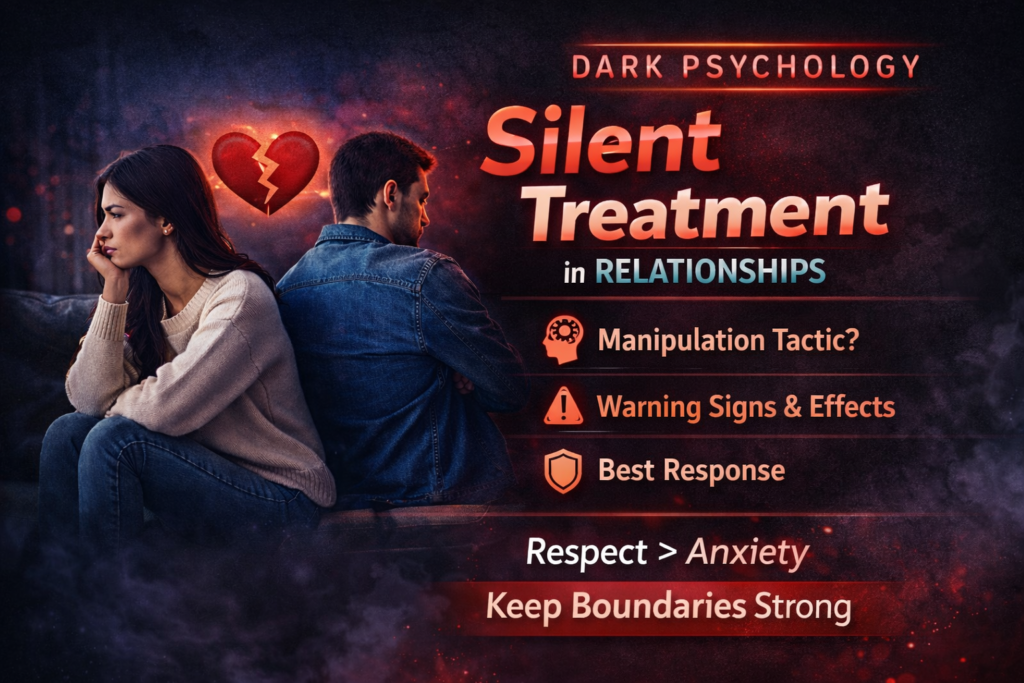
Silent treatment is not “space.” It can be emotional manipulation. Learn the signs, psychology, effects, and the best way to respond with boundaries.
Introduction
Have you ever been in a situation where someone suddenly stops replying, ignores your calls, or becomes cold and silent—and you keep thinking:
“What did I do wrong?”
Sometimes people genuinely need time to calm down.
But many times, silence is used as a punishment and a way to control you. This is called the silent treatment.
In a healthy relationship, problems are solved through communication.
In a toxic relationship, silence is used to create fear, guilt, and pressure.
What Is Silent Treatment?
Silent treatment means someone intentionally stops talking to you to make you feel upset, anxious, or guilty.
It can look like this:
- No replies to messages
- Ignoring calls
- Acting cold and distant
- Being in the same room but not speaking
- Saying “Nothing is wrong” while clearly avoiding you
- Disappearing for hours or days without explanation
Silent treatment is not always about peace. Many times, it’s about power.
Silent Treatment vs Healthy Space (Important Difference)
People often confuse silent treatment with needing space. But there is a big difference.
Healthy Space Looks Like:
- “I’m upset, I need some time to calm down.”
- Clear time limit: “Let’s talk in 1 hour.”
- Respectful communication
- They return and discuss the issue
Silent Treatment Looks Like:
- No explanation at all
- No timeline
- Cold behavior to punish you
- You feel pressured to chase and fix things
- They come back only when they want, like nothing happened
Simple rule:
Healthy space = to calm down and solve the problem.
Silent treatment = to punish you and control you.
Why People Use Silent Treatment (The Psychology)
Silent treatment works because it affects your mind emotionally.
1) It Creates Anxiety and Overthinking
When someone goes silent, your brain feels unsafe.
You start thinking:
- “Are they leaving me?”
- “Did I ruin everything?”
- “Should I message again?”
This makes you chase them for peace.
2) It Pushes You to Apologize Even When You’re Not Wrong
When you feel anxious, you want the silence to stop.
So you may say sorry just to “fix” the situation.
That’s how control increases.
3) It Avoids Real Communication
Silent treatment is easier than solving problems.
Instead of talking like a mature person, they use silence as a weapon.
4) It Makes Them Feel Powerful
The person using silent treatment often feels:
“I have control because you need my attention.”
This is not love. This is emotional control.
Signs You Are Facing Silent Treatment
Here are clear signs:
- They ignore you without a reason
- They don’t tell you when they will talk
- They punish you with silence after arguments
- They act like you don’t exist
- They return only when they want something
- You feel scared to express your feelings
- You always end up apologizing first
If this pattern repeats, it’s a red flag.
How Silent Treatment Affects You
Silent treatment can damage your mental health over time.
Emotional effects:
- Anxiety
- Low confidence
- Constant overthinking
- Fear of abandonment
- Feeling “not good enough”
Relationship effects:
- Lack of trust
- Poor communication
- Emotional distance
- Unhealthy attachment
- Power imbalance
Over time, you may start losing your self-respect just to keep the relationship alive.
The Best Way to Respond to Silent Treatment
The biggest mistake people make is begging or chasing.
That gives the other person more control.
The Best Response (Simple and Strong)
Say one clear line:
“When you’re ready to talk calmly and respectfully, I’m here.”
Then stop chasing. Maintain distance.
This does two things:
- It shows you are mature
- It protects your self-respect
What NOT to Do
Avoid these actions:
❌ Sending 20 messages
❌ Calling again and again
❌ Explaining too much
❌ Saying sorry just to end the silence
❌ Accepting the same behavior repeatedly
The more you chase, the more the silent treatment works.
When Silent Treatment Becomes Emotional Abuse
Silent treatment becomes emotional abuse when:
- It happens often
- It lasts for long periods (days)
- It’s used to punish, threaten, or control
- Your feelings are ignored every time
- You feel emotionally trapped
In such cases, boundaries are necessary—and sometimes leaving is the healthiest option.
Healthy Alternatives to Silent Treatment
If someone needs time, this is a healthy way to say it:
✅ “I’m feeling overwhelmed. I need 30 minutes. Let’s talk after that.”
✅ “I’m upset, but I want to solve this calmly.”
✅ “I need space right now, but I won’t ignore you.”
Healthy love gives clarity, not confusion.
Final Thoughts
Silent treatment is not always silence.
Many times, it’s a message:
“I want control.”
Real love doesn’t punish you with silence.
Real love communicates.
Remember:
If respect is missing, attachment has no value.
Short breaks to calm down are okay, if they communicate clearly.
Ignoring you without explanation is not okay.
If someone disappears for hours or days repeatedly to punish you, it’s unhealthy.
“When you’re ready to talk respectfully, I’m here.”